
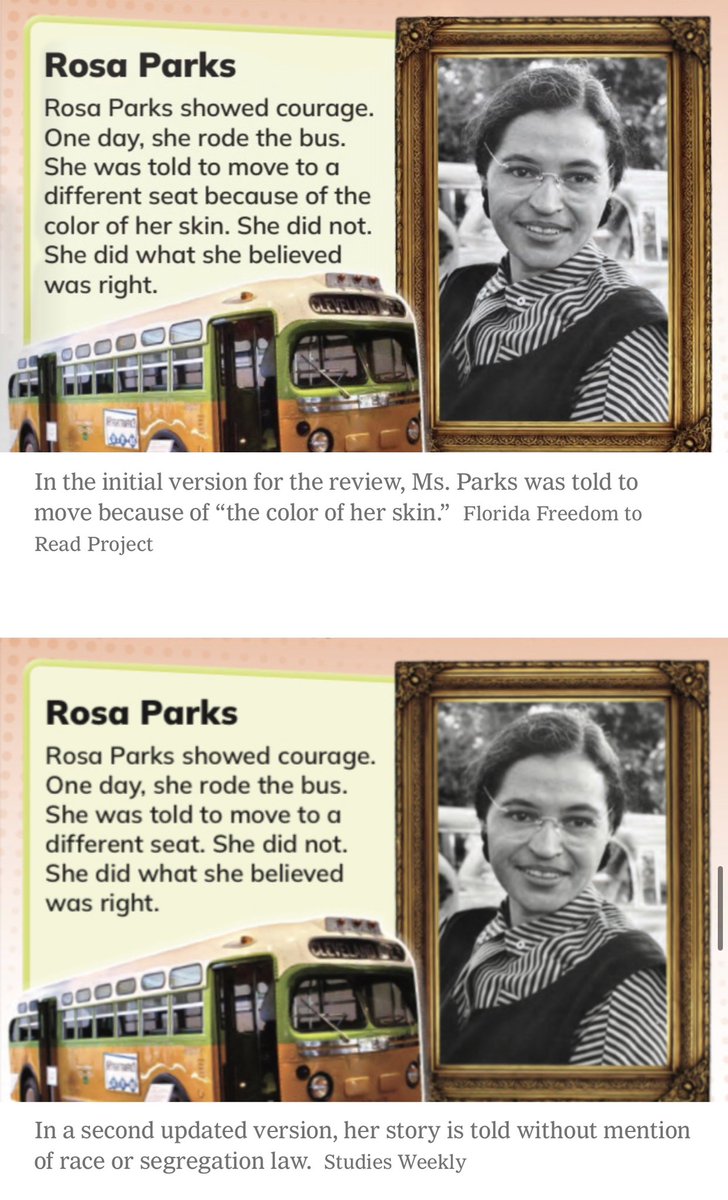

The statement is critical of a textbook publisher's interpretation of a law, suggesting that it led to the omission of important historical context regarding race in the story of Rosa Parks. The statement implies that such an interpretation may not be suitable for educational curriculum. The image shows two versions of how Rosa Parks' story is presented, with the first mentioning race and the second omitting it. The tone is one of concern and critique regarding educational content and the implications of censorship or alteration of historical facts.
- The statement aims to highlight the importance of accurate historical representation, which aligns with doing no harm as it seeks to preserve the integrity of educational materials. [+1]Principle 1:I will strive to do no harm with my words and actions.
- The statement respects the dignity of Rosa Parks by advocating for the complete and accurate telling of her story, which is central to understanding the historical context of her actions. [+1]Principle 2:I will respect the privacy and dignity of others and will not engage in cyberbullying, harassment, or hate speech.
- The statement encourages a dialogue about the appropriateness of educational content and the interpretation of laws affecting it, promoting understanding of the potential impact of such interpretations. [+1]Principle 4:I will engage in constructive criticism and dialogue with those in disagreement and will not engage in personal attacks or ad hominem arguments.
- The statement uses its influence to question the suitability of a publisher's content for educational purposes, aiming for the betterment of society by ensuring historical accuracy in education. [+1]Principle 6:I will use my influence for the betterment of society.
- The statement upholds the principles of free speech by using the platform to discuss and critique the actions of the textbook publisher responsibly. [+1]Principle 7:I will uphold the principles of free speech and use my platform responsibly and with integrity.