
Office of the Governor of California
@CAgovernor
·
983d
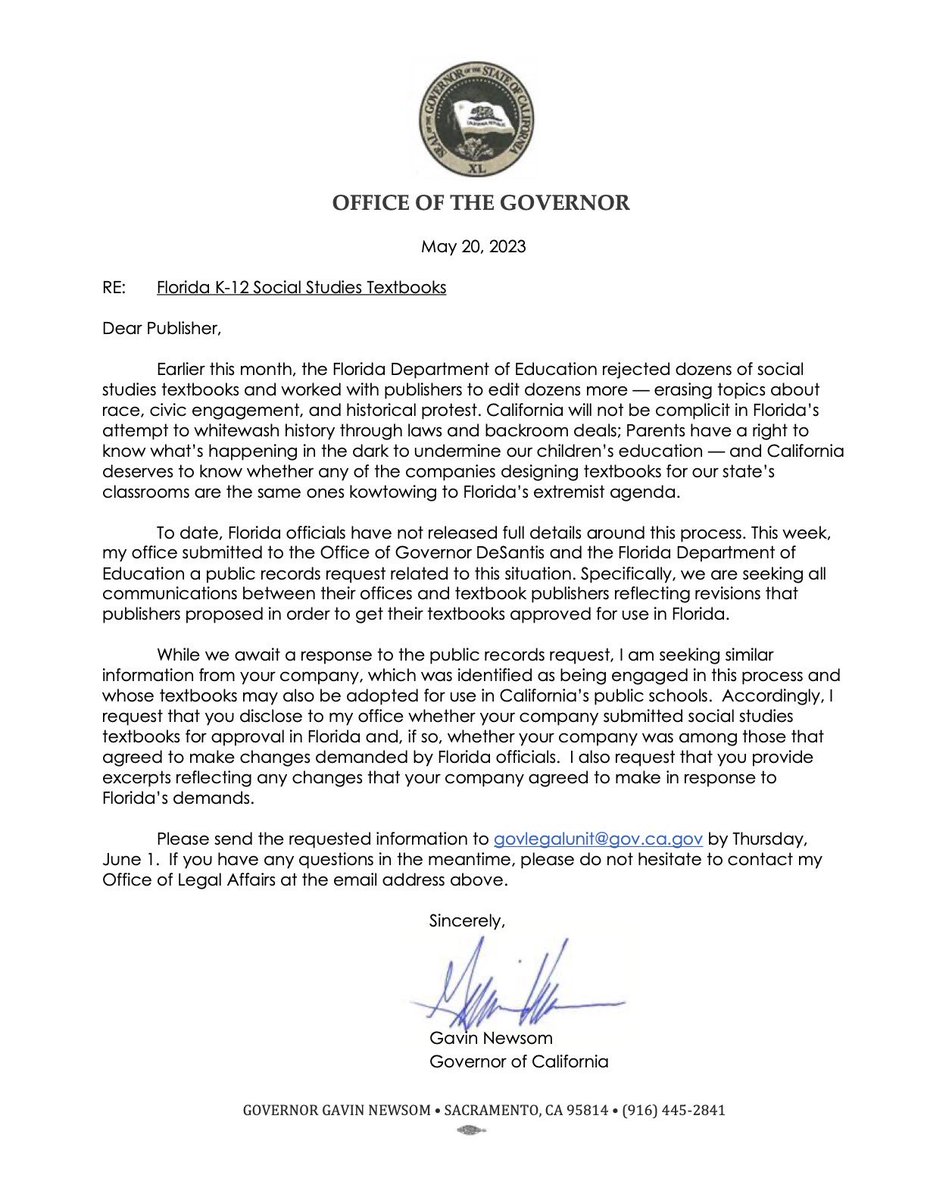

The statement expresses concern about the integrity of educational materials and the potential rewriting of history. It implies a commitment to transparency and historical accuracy, and it criticizes actions that may undermine these values. The tone is assertive and suggests a call to action against what the speaker perceives as an attempt to distort historical facts. The image provided is a letter from the Governor of California addressing the issue of textbook content and requesting information from publishers, which supports the statement's context.
- The statement aims to prevent harm by ensuring historical accuracy in education. [+1]Principle 1:I will strive to do no harm with my words and actions.
- The statement respects the dignity of historical figures and events by opposing their erasure. [+1]Principle 2:I will respect the privacy and dignity of others and will not engage in cyberbullying, harassment, or hate speech.
- The statement promotes understanding by advocating for accurate historical representation. [+1]Principle 4:I will engage in constructive criticism and dialogue with those in disagreement and will not engage in personal attacks or ad hominem arguments.
- The statement is part of a dialogue addressing a disagreement over educational content. [+1]Principle 5:I will acknowledge and correct my mistakes.
- The statement seeks to correct what the speaker sees as a mistake in the handling of educational materials. [+1]Principle 6:I will use my influence for the betterment of society.
- The statement uses the speaker's platform to address a public concern responsibly. [+1]Principle 7:I will uphold the principles of free speech and use my platform responsibly and with integrity.