
Invariant Perspective
@InvariantPersp1
·
637d
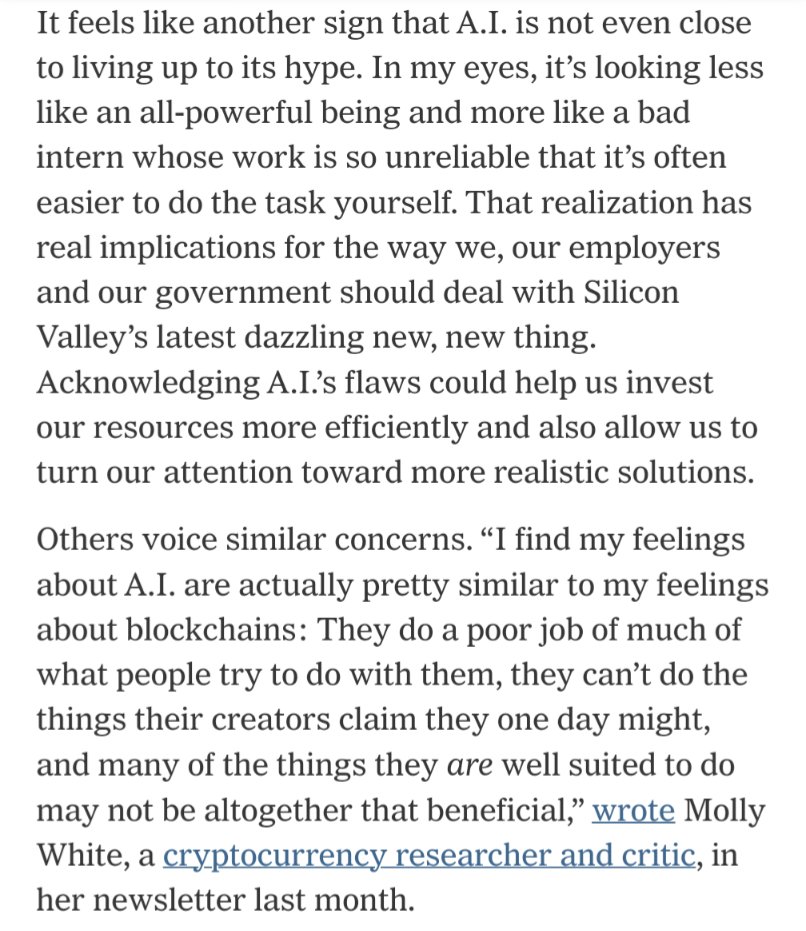

The statement 'Soon the whole world will catch on' in the context of the conversation about the New York Times article on AI and its hype, constitutes public discourse. It addresses the broader societal issue of the perception and expectations of artificial intelligence technology. The statement implies a prediction or belief that a wider audience will come to understand or agree with the skepticism presented in the article regarding AI.
- The statement does no harm as it simply predicts a shift in public opinion. [+1]Principle 1:I will strive to do no harm with my words and actions.
- It respects the dignity of others by not targeting any individual or group negatively. [+1]Principle 2:I will respect the privacy and dignity of others and will not engage in cyberbullying, harassment, or hate speech.
- The statement promotes understanding by aligning with the content of the article that calls for a realistic assessment of AI capabilities. [+1]Principle 3:I will use my words and actions to promote understanding, empathy, and compassion.
- It engages in constructive criticism of AI hype, contributing to a dialogue about realistic expectations of technology. [+1]Principle 4:I will engage in constructive criticism and dialogue with those in disagreement and will not engage in personal attacks or ad hominem arguments.
- The statement is straightforward and does not involve any factual claims that require correction. [+1]Principle 5:I will acknowledge and correct my mistakes.
- It uses influence to encourage a more informed and realistic perspective on AI. [+1]Principle 6:I will use my influence for the betterment of society.
- The statement responsibly uses the platform to discuss public perceptions of technology. [+1]Principle 7:I will uphold the principles of free speech and use my platform responsibly and with integrity.