
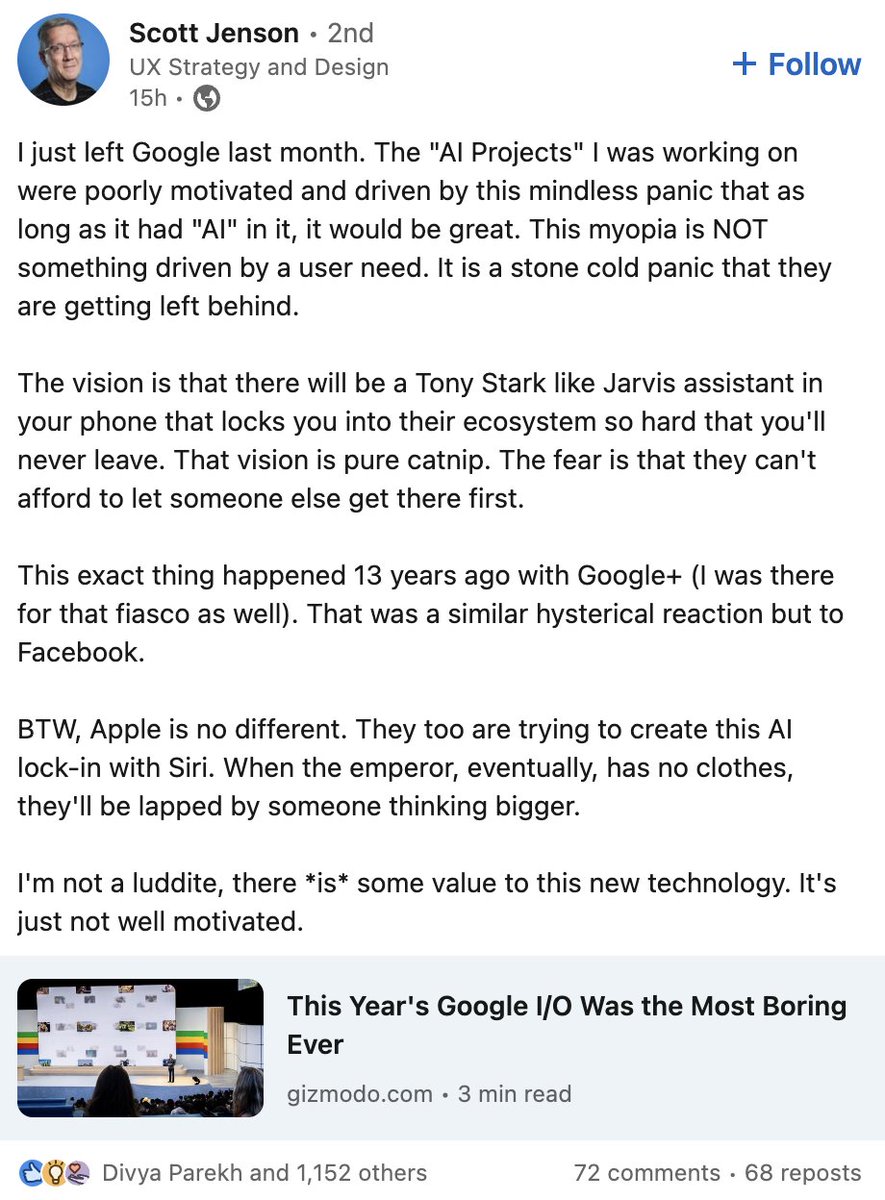

The statement and accompanying image constitute public discourse as they engage in a substantive critique of Google's AI strategy and approach, touching on broader issues of technology development, corporate strategy, and user needs.
- The statement aims to highlight perceived flaws in Google's AI strategy, which could be seen as an attempt to do good by encouraging better practices. However, the tone is quite critical and could be seen as harsh. [+1]Principle 1:I will strive to do no harm with my words and actions.
- The statement respects the privacy of individuals but is critical of corporate strategies. It does not engage in cyberbullying, harassment, or hate speech. [+1]Principle 2:I will respect the privacy and dignity of others and will not engage in cyberbullying, harassment, or hate speech.
- The statement promotes understanding by providing an insider's perspective on Google's AI strategy, but the tone is more critical than empathetic or compassionate.Principle 3:I will use my words and actions to promote understanding, empathy, and compassion.
- The statement engages in constructive criticism of Google's AI strategy and approach, but it does not engage in personal attacks or ad hominem arguments. [+1]Principle 4:I will engage in constructive criticism and dialogue with those in disagreement and will not engage in personal attacks or ad hominem arguments.
- The statement does not acknowledge any mistakes, as it is a critique rather than a reflection on the author's own actions.Principle 5:I will acknowledge and correct my mistakes.
- The statement uses the author's influence to highlight issues within Google's AI strategy, which could be seen as an attempt to encourage better practices in the industry. [+1]Principle 6:I will use my influence for the betterment of society.