
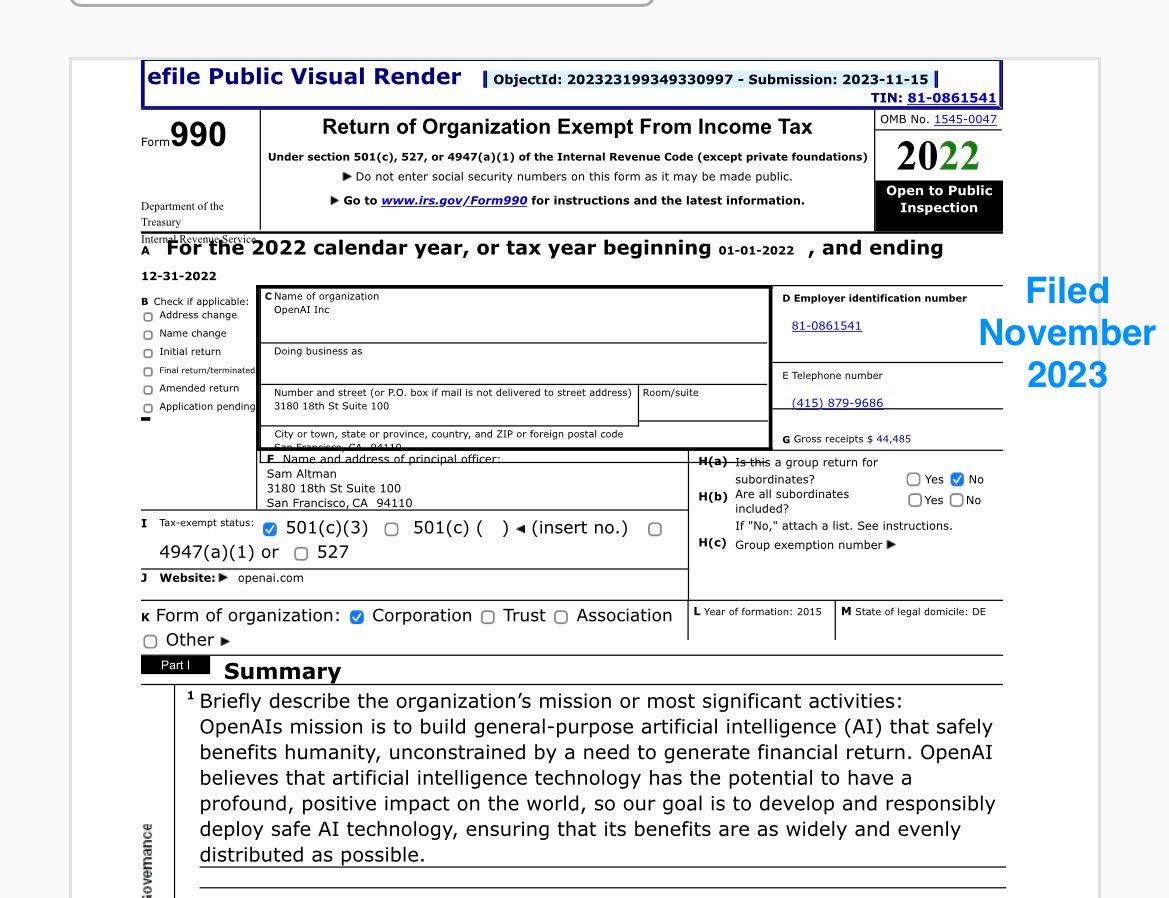

The statement critiques OpenAI's commitment to creating AI that benefits humanity without the need for financial return, referencing a specific filing to support the claim. The tone is critical and aims to hold OpenAI accountable to its stated mission. The inclusion of the image of the tax-exempt form adds credibility to the argument.
- The statement does not appear to cause harm directly but raises concerns about potential discrepancies between OpenAI's stated mission and its actions. This aligns with the principle of doing no harm by promoting transparency. [+1]Principle 1:I will strive to do no harm with my words and actions.
- The statement respects the privacy and dignity of others, focusing on the organization's actions rather than engaging in personal attacks or harassment. [+1]Principle 2:I will respect the privacy and dignity of others and will not engage in cyberbullying, harassment, or hate speech.
- By questioning OpenAI's adherence to its mission, the statement promotes understanding and accountability, which can lead to more ethical practices in AI development. [+1]Principle 3:I will use my words and actions to promote understanding, empathy, and compassion.
- The statement engages in constructive criticism by providing evidence (the tax-exempt form) to support its claims, rather than resorting to personal attacks. [+1]Principle 4:I will engage in constructive criticism and dialogue with those in disagreement and will not engage in personal attacks or ad hominem arguments.
- The statement uses its platform to potentially better society by advocating for ethical practices in AI development, which aligns with the principle of using influence for societal betterment. [+1]Principle 6:I will use my influence for the betterment of society.
- The statement upholds free speech principles by responsibly critiquing a public organization's actions and encouraging dialogue on important issues. [+1]Principle 7:I will uphold the principles of free speech and use my platform responsibly and with integrity.