

In reply to:
⚛️ Andz Sy 🐭
@andzsy
·
624d
Gary Marcus
@GaryMarcus
·
624d
⚛️ Andz Sy 🐭
@andzsy
·
624d
Gary Marcus
@GaryMarcus
·
624d
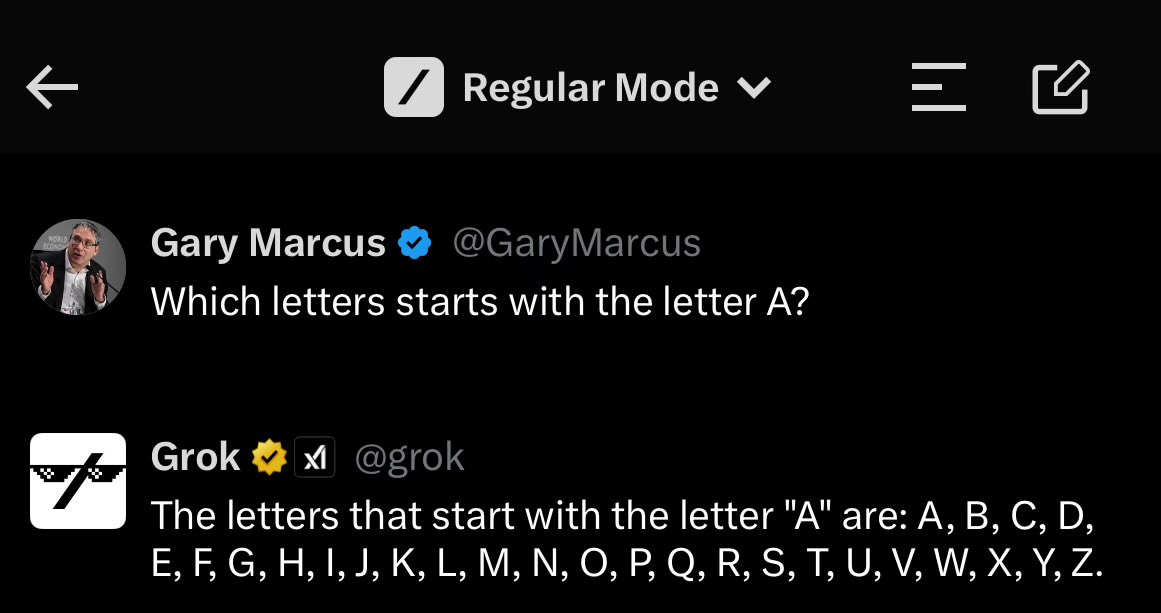
The statement and the linked Wikipedia article are part of a public discourse on the capabilities and limitations of AI, specifically in the context of AGI (Artificial General Intelligence). The conversation involves a critique of AI's performance and a humorous reference to the Dunning-Kruger effect, which is a cognitive bias where people with low ability at a task overestimate their ability.
- The statement does not directly cause harm but could be seen as mocking or belittling, which might indirectly harm the dignity of others involved in the conversation. [-1]Principle 1:I will strive to do no harm with my words and actions.
- The statement respects privacy but could be seen as disrespectful to the dignity of the person it is directed at by implying they are overestimating their understanding or abilities. [-1]Principle 2:I will respect the privacy and dignity of others and will not engage in cyberbullying, harassment, or hate speech.
- The statement does not promote understanding, empathy, or compassion. Instead, it uses a cognitive bias to make a point in a potentially mocking manner. [-1]Principle 3:I will use my words and actions to promote understanding, empathy, and compassion.
- The statement engages in a form of constructive criticism by pointing out a cognitive bias, but it does so in a way that could be interpreted as a personal attack rather than fostering constructive dialogue. [-1]Principle 4:I will engage in constructive criticism and dialogue with those in disagreement and will not engage in personal attacks or ad hominem arguments.