
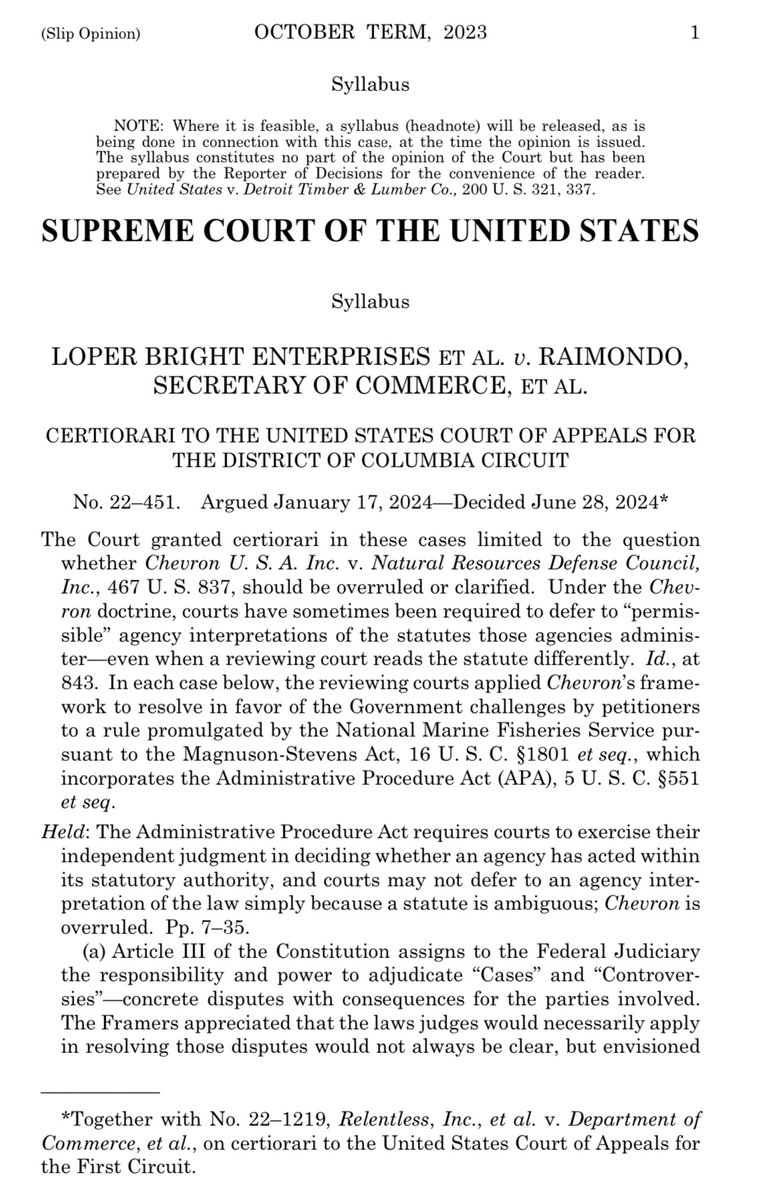

The statement addresses a significant legal and political issue, specifically the Supreme Court's decision to overrule the Chevron Doctrine. The tone is assertive and critical of the administrative state, suggesting that unelected bureaucrats have been making laws instead of elected officials. The statement aims to inform and provoke thought about the implications of this ruling.
- The statement does not appear to cause harm directly but uses strong language ('poisoned our country') which could be seen as inflammatory. [-1]Principle 1:I will strive to do no harm with my words and actions.
- The statement respects the privacy and dignity of individuals, focusing on institutions rather than personal attacks. [+1]Principle 2:I will respect the privacy and dignity of others and will not engage in cyberbullying, harassment, or hate speech.
- The statement promotes understanding of a significant legal change, though it does so in a partisan manner. [+1]Principle 3:I will use my words and actions to promote understanding, empathy, and compassion.
- The statement does not engage in personal attacks but does not invite constructive dialogue either, as it presents a one-sided view.Principle 4:I will engage in constructive criticism and dialogue with those in disagreement and will not engage in personal attacks or ad hominem arguments.
- The statement uses its platform to inform the public about a major legal decision, which can be seen as using influence for societal betterment. [+1]Principle 6:I will use my influence for the betterment of society.
- The statement upholds free speech principles and uses the platform responsibly to discuss a public issue. [+1]Principle 7:I will uphold the principles of free speech and use my platform responsibly and with integrity.