
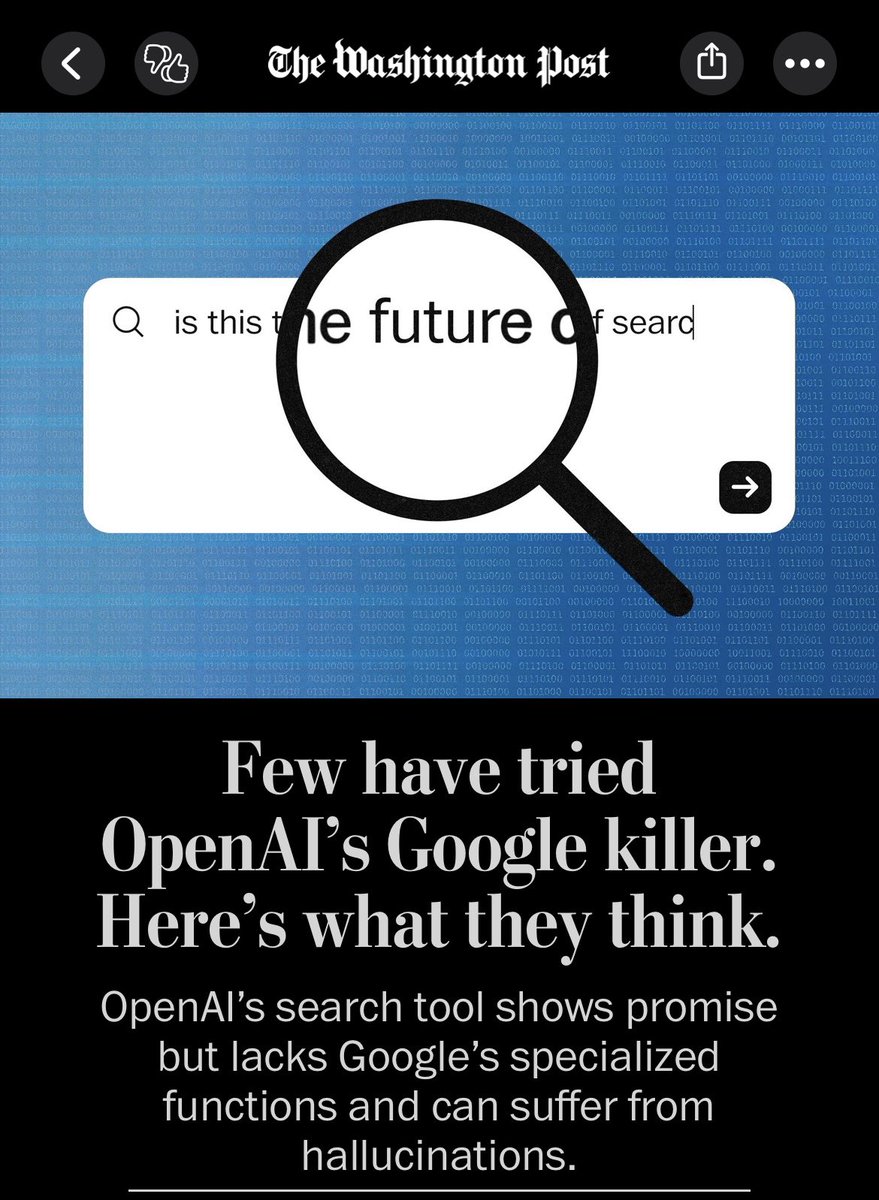

The statement and accompanying image engage in public discourse by addressing the performance and reliability of a new AI search tool developed by OpenAI. The statement expresses surprise at the tool's potential for 'hallucinations,' a term used to describe AI generating incorrect or nonsensical information. The image from The Washington Post provides context, suggesting that the tool, while promising, has limitations compared to Google's search capabilities.
- The statement does not appear to cause harm directly but could contribute to skepticism or concern about the reliability of AI tools. It is neutral in tone and does not engage in harmful rhetoric.Principle 1:I will strive to do no harm with my words and actions.
- The statement could promote understanding by highlighting a potential issue with AI technology, encouraging further discussion and scrutiny. However, it lacks depth in explaining the issue, which could limit its effectiveness in fostering empathy or compassion. [+1]Principle 3:I will use my words and actions to promote understanding, empathy, and compassion.
- The statement does not engage in personal attacks or ad hominem arguments. It focuses on the technology rather than individuals or groups. [+1]Principle 4:I will engage in constructive criticism and dialogue with those in disagreement and will not engage in personal attacks or ad hominem arguments.
- By bringing attention to the limitations of AI technology, the statement could be seen as using influence to encourage critical evaluation and improvement of such tools, which can be beneficial for society. [+1]Principle 6:I will use my influence for the betterment of society.