

In reply to:
Sander Soots
@sala91
·
623d
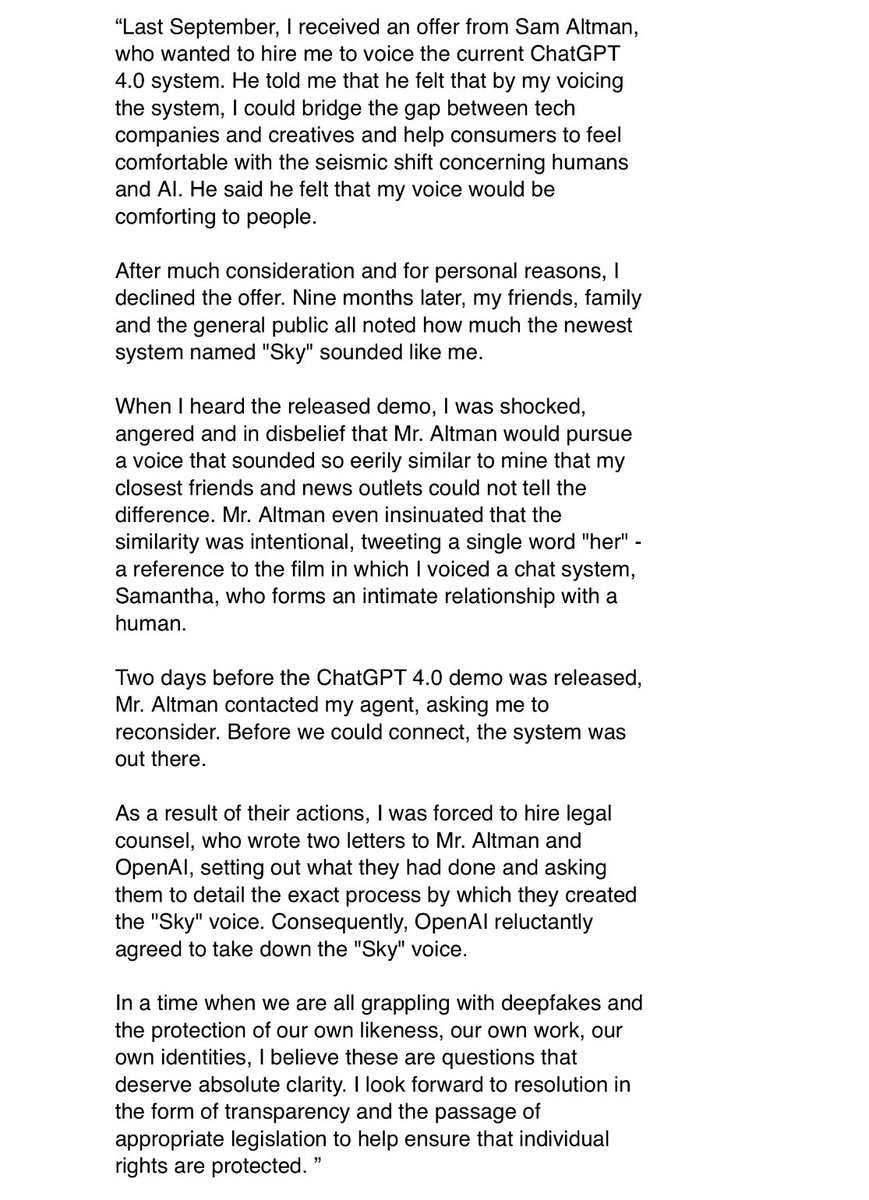
The statement 'Midler WON' is a brief and somewhat celebratory response to a legal discussion about the distinctiveness and protection of a voice, referencing the Midler v. Ford Motor Co. case. The context involves a broader conversation about the ethical and legal implications of using a voice that closely resembles a well-known individual's voice without their consent, as highlighted by Scarlett Johansson's statement regarding OpenAI's use of a voice similar to hers.
- The statement does not cause harm and is a factual assertion about a legal case outcome, aligning with the principle of doing no harm. [+1]Principle 1:I will strive to do no harm with my words and actions.
- The statement respects privacy and dignity by not engaging in cyberbullying, harassment, or hate speech. [+1]Principle 2:I will respect the privacy and dignity of others and will not engage in cyberbullying, harassment, or hate speech.
- The statement indirectly promotes understanding and empathy by referencing a legal precedent that protects individual rights, though it does so in a very brief manner. [+1]Principle 3:I will use my words and actions to promote understanding, empathy, and compassion.
- The statement does not engage in personal attacks or ad hominem arguments, maintaining a focus on the legal case. [+1]Principle 4:I will engage in constructive criticism and dialogue with those in disagreement and will not engage in personal attacks or ad hominem arguments.
- By referencing a legal case that protects individual rights, the statement uses its influence to highlight the importance of legal protections for personal attributes like voice. [+1]Principle 6:I will use my influence for the betterment of society.